Who is Revenue Share Digital For?
I partner exclusively with a small number of serious, ambitious ecommerce stores and service based businesses (£3K AOV+) such as Driveways, Roofing, Windows & Doors, Rendering & Coatings, Solar Panels, Garden Rooms, Loft/Garage Conversions, Landscaping and Fencing/Decking and want a true marketing partner — I'm someone who doesn’t just generate sales and leads, but who shares in the risk, the work, and the upside. I can only work with a select number of businesses at any one given time. Please check below to see if your business is eligible.
How I Generate Leads on Autopilot

Step 1 - High-Converting Sales Funnel
I'll design, build, host and manage high converting sales funnel for your business that turns visitors into sales.
I'll use the exact same high-converting funnel templates that I've used to generated over $3M worth of business over the last few years.
No more static 'brochure-style' websites that don't generate laser focused, highly-qualified leads.
You'll get a high converting sales funnel and website that generates
leads on auto-pilot.
Step 2 - Laser Targeted Traffic
I'll build, manage and optimise a series laser targeted SEO, Google Ads, Meta Ads, Organic Social & Automated Email campaigns to maximise your exposure across all relevant channels to attract a steady flow of highly qualified leads.
- Google Search
- Google Ads
- Facebook Ads
- Instagram Ads
And wherever else your target audience hangs out online.

Case Studies
I can't guaranteed these results for you but it shows what could happen.
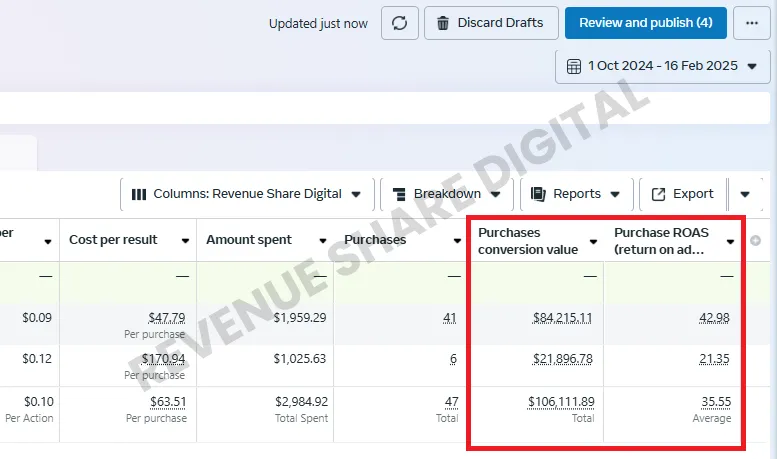
CASE STUDY
A Technology Store Has Increased Revenue by 106.1K in Just 4 Months With a 3550% ROAS
CASE STUDY
A Technology Store Has Increased Revenue by 106.1K in Just 4 Months With a 3550% ROAS
CASE STUDY
A Clothing & Apparel Store Has Increased Total Revenue by 40% in Just 4 Months
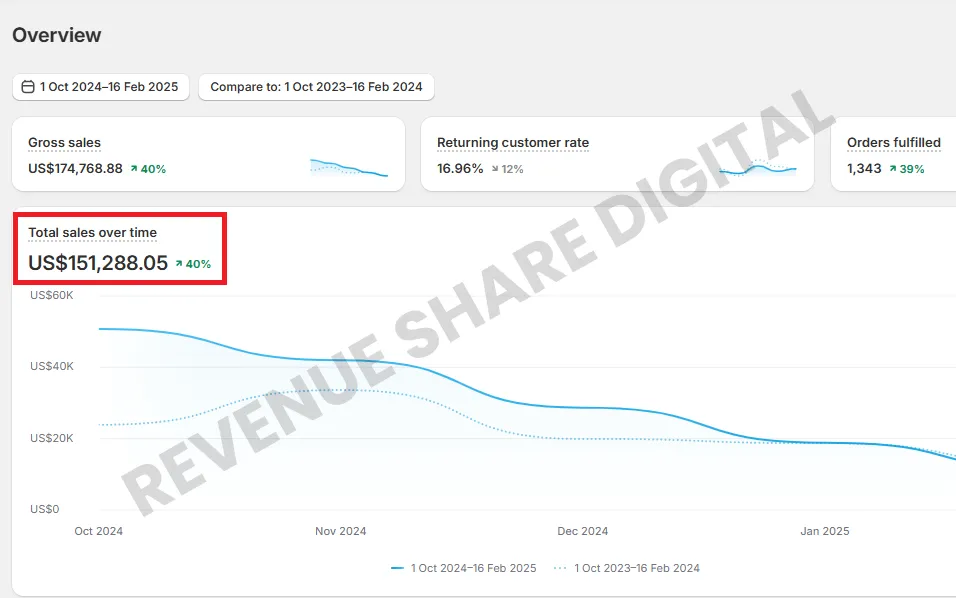
CASE STUDY
A Clothing & Apparel Store Has Increased Total Revenue by 40% in Just 4 Months
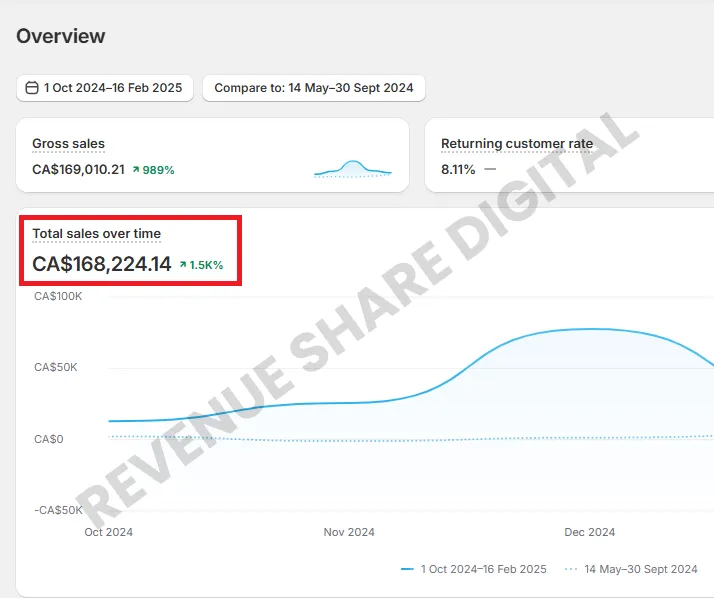
CASE STUDY
An Electronics Store Has Increased Increased Total Revenue By 1500% in 115 Days
CASE STUDY
An Outdoor Living Company Has Gone From £17K/pm To £82.6K/pm in 142 Days

CASE STUDY
An Outdoor Living Company Has Gone From £17K/pm To £82.6K/pm in 142 Days
Step 2 - Laser Targeted Traffic
I'll build, manage and optimise a series laser targeted SEO, Google Ads, Meta Ads, Organic Social & Automated Email campaigns to maximise your exposure across all relevant channels to attract a steady flow of highly qualified leads.
- Google Search
- Google Ads
- Facebook Ads
- Instagram Ads
And wherever else your target audience hangs out online.
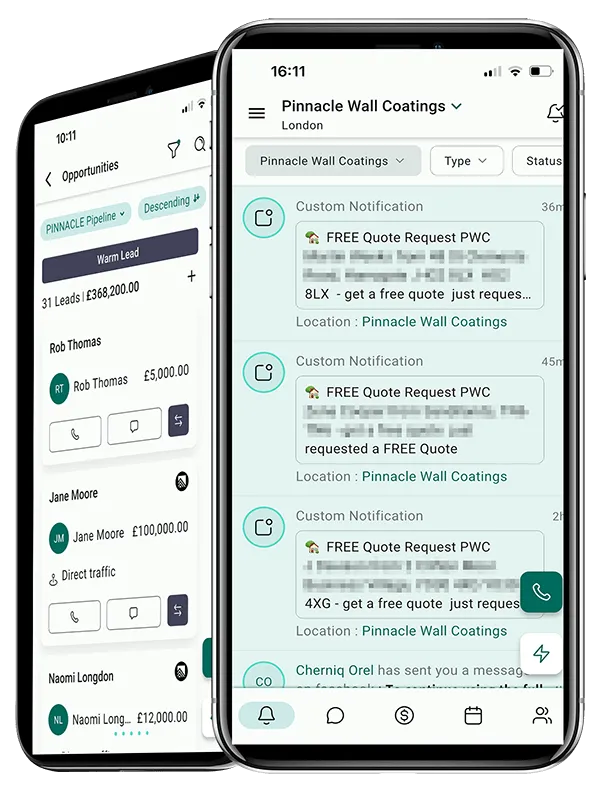
Step 3 - Lead Notifications
I'll design, build, host and manage high converting sales funnel for your business that turns visitors into sales.
I'll use the exact same high-converting funnel templates that I've used to generated over $3M worth of business over the last few years.
No more static 'brochure-style' websites that don't generate laser focused, highly-qualified leads.
You'll get a high converting sales funnel and website that generates
leads on auto-pilot.
Step 4 - Performance Managment
I'll build, manage and optimise a series laser targeted SEO, Google Ads, Meta Ads, Organic Social & Automated Email campaigns to maximise your exposure across all relevant channels to attract a steady flow of highly qualified leads.
- Google Search
- Google Ads
- Facebook Ads
- Instagram Ads
And wherever else your target audience hangs out online.
Step 4 - Performance Management
I'll build, manage and optimise a series laser targeted SEO, Google Ads, Meta Ads, Organic Social & Automated Email campaigns to maximise your exposure across all relevant channels to attract a steady flow of highly qualified leads.
- Google Search
- Google Ads
- Facebook Ads
- Instagram Ads
And wherever else your target audience hangs out online.
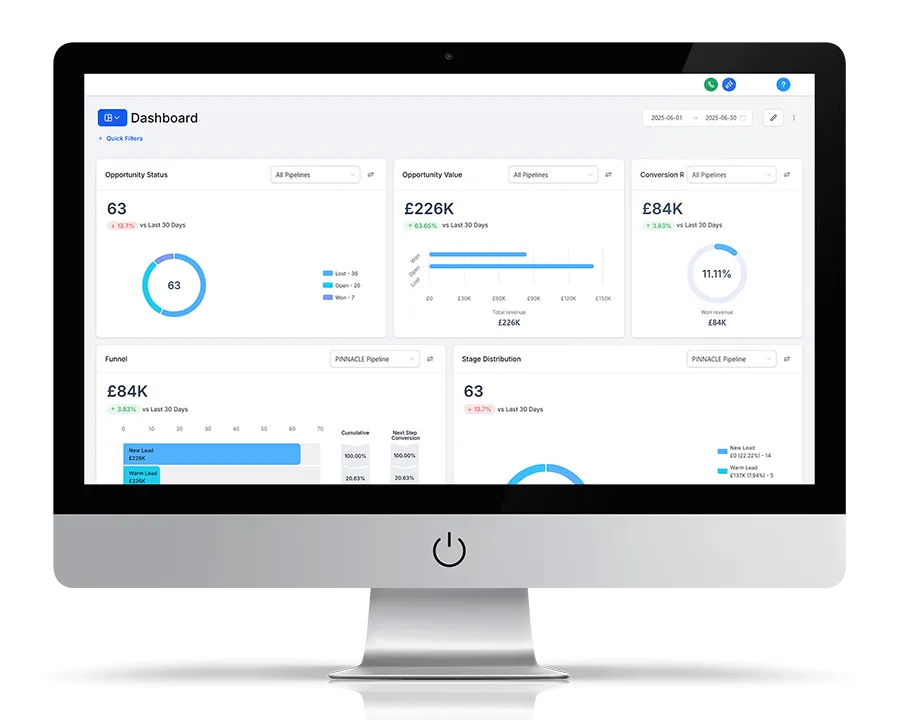
Step 5 - Scaling & Optimisation
We work together and I scale and optimize marketing budget for consistent and predictable sales growth.
Instead of burning money on marketing, let me build you a scalable, automated customer acquisition machine that works even while you sleep and only costs you when you close leads.
Case Study

From £17K To £100K+ Per Month In Just 3 Months
Company: An exterior wall coating company covering the whole of England & Wales.
Problem: Low converting WordPress website and had tried multiple agencies and so called experts at great expense with no success in generating leads whatsoever.
Solution: High converting sales funnel and nationwide lead generation solution with expert SEO, Google and Meta/Facebook ads optimisation and management.
Payment Option: Revenue Share
Results: 623.5% YOY Monthly Revenue Growth. Blended revenue ROAS of 2080%

"Exceptional Results"
Working with RSD completely transformed the way we win leads and new business. Before, we were stuck in a vicious circle of trying and failing with multiple agencies and inconsistent enquiries.
Within weeks of partnering, we started receiving a steady flow of high-quality, exclusive leads that were actually ready to buy—not just tyre kickers. The transparency, honesty, and attention to detail have been second to none.
What really stands out is the ROI. For every pound we’ve invested in marketing, we’ve seen many times that back in confirmed jobs.
We’ve closed projects we never would have reached without this and have added six figures to our monthly turnover.
If you’re serious about growing your business, this isn’t just another ‘lead gen service’—it’s a true partnership. RSD delivers exactly what it promises, and I honestly can’t recommend this partnership highly enough."*
— J. Jackson, Partner - Pinnacle Wall Coatings
Cost of Motor Vehicle Accident Leads: What PI Firms Should Really Expect to Pay.
By K Atkinson.
Founder, MVA Leads Direct
Specialising in state-level personal injury acquisition and scalable MVA case infrastructure
Overview.
The cost of motor vehicle accident leads is one of the most misunderstood variables in personal injury acquisition.
Most discussions focus on cost per lead. Serious firms focus on cost per retained case.
A $350 lead with poor intake conversion can be more expensive than a $700 lead that converts consistently. A high-cost state with strong case value may outperform a lower-cost state with weaker recoveries. Media volatility can distort short-term expectations. Close rate drift can quietly compress margin.
The correct question is not: How much do MVA leads cost?
The correct question is: At what cost per retained case does MVA acquisition remain economically rational for our firm?
This article breaks down:
- Realistic pricing ranges in today’s market
- How state-level variance affects cost
- Exclusive vs shared pricing differences
- How intake speed changes effective economics
- How to model risk before scaling
- When higher lead cost is actually a competitive advantage
For foundational context on acquisition mechanics, review How Motor Vehicle Accident Lead Generation Works.
Table of Contents.
01 - Understanding the Real Pricing Landscape
02 - Typical Market Ranges (2024–2025 Environment)
03 - Why Cost Per Lead Is the Wrong Anchor
04 - State-Level Cost Variance Is Real
05 - Exclusive vs Shared: How Pricing Diverges
06 - Qualification Depth Changes Cost
07 - How Intake Conversion Changes Everything
08 - Volume Commitments and Pricing Power
09 - Risk Modelling Before You Scale
10 - When Higher Lead Cost Is Actually Advantageous
11 - What Serious Firms Should Expect
12 - A Practical Decision Framework
To Summarize
FAQ's
01
Understanding the Real Pricing Landscape.
There is no universal national price for motor vehicle accident leads.
Pricing is influenced by:
- Jurisdiction competitiveness
- Media buying cost in that state
- Distribution model (exclusive vs shared)
- Qualification filtering depth
- Recency standards
- Volume commitment
That said, serious operators should expect realistic market ranges.
Typical Market Ranges (2024–2026 Environment)
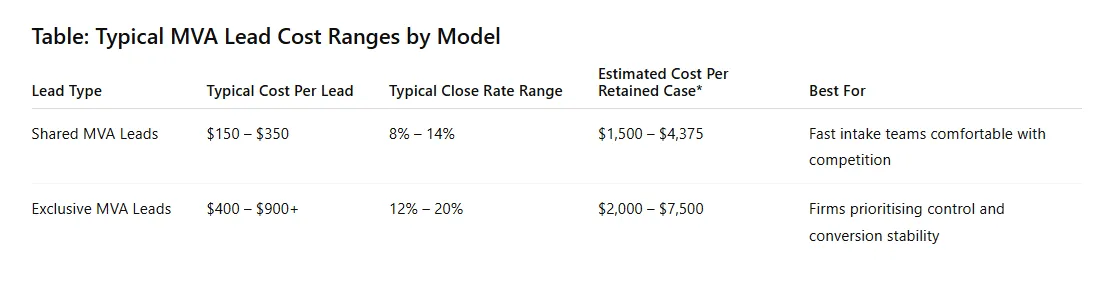
Shared MVA Leads: Often range from approximately $150–$350 per lead depending on geography and filtering.
Exclusive MVA Leads: Commonly range from $400–$900+ per lead in competitive states.
Highly competitive urban markets can exceed those ranges, particularly in states such as California and Florida, where auction intensity drives underlying media cost.
These are not promises. They are realistic market observations.
If you are being offered “exclusive MVA leads” at $120 nationwide, either filtering is extremely broad or distribution is not truly exclusive.
02
Why Cost Per Lead Is the Wrong Anchor.
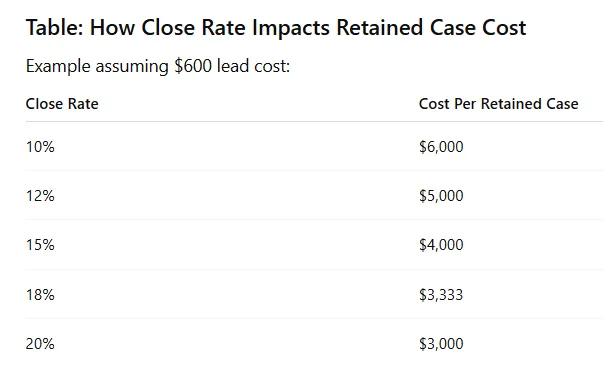
Cost per lead is easy to compare. It is also dangerously incomplete. What determines profitability is cost per retained case.
The simplified formula remains:
Cost per retained case = Cost per lead ÷ Close rate
If your close rate is 12% and you pay $500 per lead:
- $500 ÷ 0.12 = $4,166 per signed case
f your close rate is 18% at the same lead cost:
$500 ÷ 0.18 = $2,777 per signed case
That difference is strategic.
This is why firms that obsess over reducing CPL often damage their economics by widening qualification filters, increasing intake burden, and lowering close rate.
The objective is not cheap leads.
The objective is controlled retained case cost.
For a broader strategic comparison between models, see PPC vs Buying MVA Leads: Which Model Actually Scales for PI Firms?.
03
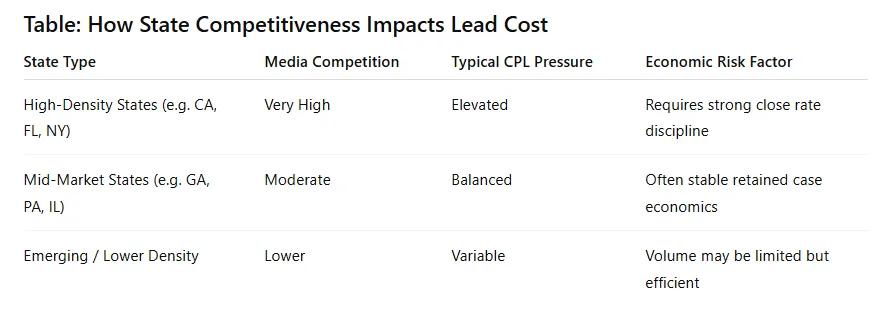
State-Level Cost Variance Is Real.
Motor vehicle accident acquisition does not scale uniformly across states. A firm expecting Texas pricing in New York will miscalculate.
Several variables drive state-level cost differences:
- CPC intensity in major metros
- Density of competing PI advertisers
- Insurance environment
- Litigation culture
- Case value expectations
For example:
In Texas for example, certain metros may offer more balanced CPC environments compared to heavily saturated markets.
In New York, competition density and regulatory nuance may influence campaign structure and cost.
In Georgia or Pennsylvania, mid-market conditions can sometimes create more stable retained case economics if intake discipline is strong.
This is why serious firms treat each state as a separate acquisition unit rather than blending performance nationally.
Blended averages conceal underperformance and distort scaling decisions.
04
Exclusive vs Shared: How Pricing Diverges.
Distribution structure directly impacts pricing. Shared leads are distributed to multiple firms. Lower cost per lead reflects shared competition risk.
Exclusive leads are delivered to a single firm. Higher price reflects reduced distribution competition and increased operational control.
The economic trade-off is straightforward:
Shared leads:
- Lower CPL
- Lower close rate
- Higher intake race pressure
Exclusive leads:
- Higher CPL
- Higher close rate potential
- Reduced competition at intake
There is no universal winner. If your intake team is aggressive and fast, shared leads can work (but not often). If your brand positioning and client experience matter deeply, exclusivity may justify higher unit cost.
Pricing should be evaluated in the context of your conversion efficiency.
05
Qualification Depth Changes Cost.
Filtering depth materially affects pricing.
More aggressive qualification typically increases lead cost because:
- Media targeting narrows
- Volume decreases
- Acquisition becomes more competitive
- Qualification variables commonly include:
- Accident recency thresholds
- Representation checks
- Liability signals
- Insurance indicators
- Injury criteria
Tighter filters improve consistency but reduce volume.
Broader filters lower CPL but increase intake workload and case variance.
If your intake team can screen efficiently, moderate filtering may be economically viable. If intake bandwidth is limited, tighter filtering may protect margin despite higher CPL.
Alignment between filtering and staffing is critical.
06
How Intake Conversion Changes Everything.
Lead cost does not determine economics. Conversion does. Two firms can buy identical exclusive leads in say Illinois at identical prices and produce entirely different retained case costs based on intake speed and follow-up discipline.
Close rate is influenced by:
- Speed to first contact
- Consistency of day-one follow-up
- Qualification scripting
- Attorney availability
- Consultation scheduling discipline
A three-point change in close rate can swing retained case cost by thousands over a monthly cohort.
Firms that complain about high CPL often have unmeasured intake inefficiency.
Lead economics reward operational maturity.
07
Volume Commitments and Pricing Power
Another overlooked variable is volume. Higher monthly commitments can sometimes stabilize pricing. Providers can forecast media spend more efficiently when volume is predictable.
However, scaling volume without intake readiness creates hidden risk.
If your firm can process 40 leads efficiently but purchases 100, close rate may decline due to operational strain.
That artificially inflates retained case cost and leads to incorrect conclusions about source quality.
Scaling should be tied to measured intake capacity, not ambition alone.
08
Risk Modelling Before You Scale.
Before increasing budget or signing larger commitments, firms should model moderate stress scenarios.
Ask:
What happens if close rate drops by three points?
What happens if average case value shifts?
What happens if intake staffing changes?
If your model collapses under mild stress, you are scaling prematurely.
Disciplined firms define an acceptable retained case cost range and refuse to exceed it, even if volume is available.
Acquisition should expand only when economics remain durable under variance.
09
When Higher Lead Cost Is Actually Advantageous.
Counterintuitively, higher lead cost can sometimes improve positioning.
In extremely competitive states like Florida or California, firms that can support higher CPL due to stronger close rates effectively outbid less disciplined competitors.
If your intake converts at 20% and competitors convert at 12%, you can sustain higher unit cost and still produce stronger retained case economics.
Conversion efficiency becomes competitive leverage.
This is why internal operational discipline often matters more than negotiated lead pricing.
10
What Serious Firms Should Expect.
Realistic expectations for established PI firms typically look like:
- Exclusive MVA leads often landing between $400–$900+ depending on state and filtering
- Shared leads often lower per unit but requiring stronger intake discipline
- Retained case cost frequently clustering in the $2,000–$5,000 range nationally depending on close rate and geography
These are broad market observations, not guarantees.
What matters is whether your model supports those economics sustainably.
11
A Practical Decision Framework.
The cost of motor vehicle accident leads is not a fixed national number. It is a variable shaped by jurisdiction, filtering, distribution structure, and operational maturity.
Serious personal injury firms do not ask, “How cheap can we buy leads?”
They ask, “At what retained case cost does this remain economically durable?”
When cost per retained case is modelled honestly, state performance is segmented properly, and intake conversion is disciplined, MVA acquisition becomes a structured growth system rather than a speculative marketing expense.
If your firm wants to evaluate alignment between pricing expectations, intake capability, and target jurisdictions, begin with the structured supply Assessment.
Frequently Asked Questions.
01
Why are MVA leads more expensive in some states?
Auction intensity, population density, advertiser competition, and case value expectations all influence underlying media cost.
02
Are cheaper leads usually worse?
Not automatically. But unusually low pricing often reflects broader filtering, shared distribution, or reduced recency standards.
03
What is a good cost per retained case?
It depends on average case value, fee structure, and firm risk tolerance. Most serious operators define an internal acceptable range and scale within it. $1500 - $4000 in the most competitive states.
04
Should we test multiple states at once?
Only if intake and measurement systems are strong. Otherwise, expand incrementally and evaluate economics by jurisdiction.
05
Is buying leads riskier than running PPC?
Both carry risk. PPC exposes you to auction volatility directly. Bought leads expose you to conversion and qualification misalignment. Risk modelling matters more than channel ideology.
06
How quickly should we scale if results look strong?
Scale cautiously. Protect close rate and intake quality before increasing volume aggressively.
07
Can small firms afford exclusive MVA leads?
If intake discipline is strong and case value supports the model, yes. The key is disciplined volume and clear economics.
This service is not designed to be everything for everyone. It is built for firms that take inbound acquisition seriously and measure success where it actually matters — at the case level.
Blog.
MVA acquisition is not a marketing tactic — it is an economic system. While pricing is set at the lead level, outcomes are determined downstream by intake execution, follow-up velocity, qualification discipline, and cost-per-retained-case modelling. This section explores the operational mechanics behind scalable motor vehicle accident lead generation for growth-focused personal injury firms.
How Motor Vehicle Accident Lead Generation Works for Growth-Focused Law Firms.
Motor vehicle accident lead generation is not simply about buying names and phone numbers. It is a structured acquisition system designed to deliver intake-ready case opportunities at a predictable cost per retained case...
PPC vs Buying MVA Leads: Which Model Actually Scales for Personal Injury Firms?
For established personal injury firms, the PPC versus bought-leads debate is rarely philosophical. It’s operational. Both models can produce signed cases. Both models can also quietly bleed margin...
Cost of Motor Vehicle Accident Leads: What PI Firms Should Really Expect to Pay.
A $350 lead with poor intake conversion can be more expensive than a $700 lead that converts consistently. A high-cost state with strong case value may outperform a lower-cost state with weaker recoveries...
Exclusive vs Shared Motor Vehicle Accident Leads: A Strategic Decision...
The decision between exclusive MVA leads and shared motor vehicle accident leads is not a pricing comparison. It is a structural acquisition decision that affects cost stability, intake pressure, capital exposure, and long-term portfolio scaling...
03
Blog Post Title Goes Here
At scale, MVA campaigns stabilise around a 15% close rate when intake is consistent and volume is sufficient. This reflects real-world performance across competitive U.S. markets, factoring in normal variation in traffic quality, response times, and follow-up — not idealised conditions or short-term tests.
04
Blog Post Title Goes Here
A $2,000 - $2.5K case cost represents sustainable, all-in acquisition at scale, absorbing normal CPL volatility and seasonal swings. It reflects outcome-level performance where experienced buyers measure success — at the signed case, not the lead.
Start With a Controlled Validation Trial...
Before scaling, lead delivery begins with a controlled initial meaningful volume designed to validate quality, intent, and operational fit under real intake conditions — with your team, your routing, and your cadence.
There is no long-term obligation. The trial exists to confirm that lead quality, delivery speed, and conversion dynamics align with your firm’s expectations before increasing volume or expanding into additional states.
Minimum trial investment: $15,000+ upfront.
This is not a proof-of-concept. It is a structured validation period with clear parameters and measurable outcomes.
Exclusive leads - no sharing.
Intent strength at meaningful volume.
Delivery speed into your intake workflow.
Operation fit before committing to higher volume.
No retainers - no long term lock-ins.
Following the initial delivery period, pacing and volume can be adjusted based on performance, intake capacity, and commercial fit. This may include increased lead volume, modified delivery parameters, or expansion into additional states.
The objective is simple: predictable, scalable MVA lead supply — without unnecessary risk on either side.